
A person has only ₹1 and ₹2 coins with her. If the total number of coins that she has is 50 and the amount of money with her is ₹75, then what is the number of ₹1 coins?
UPSC CSAT 2011 Questions
45 questions from the CSAT 2011 paper with answers and detailed solutions. Pick an option to check your answer.
Comprehension passages are not included yet.
A student has an average score of N in her first three tests. In the fourth test, she scores 20 points more than this average. What is her average score for all four tests?
What is the remainder when 17^30 is divided by 18?
A village having population of 4000 requires 150 litres of water per head per day. It has a tank measuring 20 m × 15 m × 6 m. The water of this tank will last for
Consider the following figure and answer the item that follows:
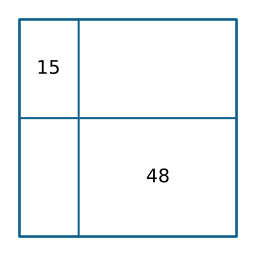
A square is divided into four rectangles as shown above.
The lengths of the side of rectangle are natural numbers. The areas of two rectangles are indicated in the figure. What is the length of each side of the square?
Three persons start walking together and their steps measure 40 cm, 42 cm and 45 cm respectively. What is the minimum distance each should walk so that each can cover the same distance in complete steps?
In a group of persons, 70% of the persons are male and 30% of the persons are married. If two-sevenths of the males are married, what fraction of the females is single?
A bus covers 160 km in 4 hours, while a train covers 320 km in 5 hours, both at uniform speeds. Find the ratio of the distances covered by the bus and train in one hour.
If 'A x B' means A is the brother of B; 'A / B' means A is the father of B and 'A + B' means A is the sister of B, which of the following means M is the uncle of P?
A, B, C, D and E are members of the same family. There are two fathers, two sons, two wives three males and two females. The teacher was the wife of a lawyer who was the son of a doctor. E is not a male, neither also a wife of a professional. C is the youngest person in the family and D is the eldest. B is a male.
How is D related to E?
A, B, C, D and E are members of the same family. There are two fathers, two sons, two wives three males and two females. The teacher was the wife of a lawyer who was the son of a doctor. E is not a male, neither also a wife of a professional. C is the youngest person in the family and D is the eldest. B is a male.
Who are the females in the group?
A, B, C, D and E are members of the same family. There are two fathers, two sons, two wives three males and two females. The teacher was the wife of a lawyer who was the son of a doctor. E is not a male, neither also a wife of a professional. C is the youngest person in the family and D is the eldest. B is a male.
Whose wife is the teacher?
Consider the four age pyramids given below namely A, B, C and D representing four different countries.
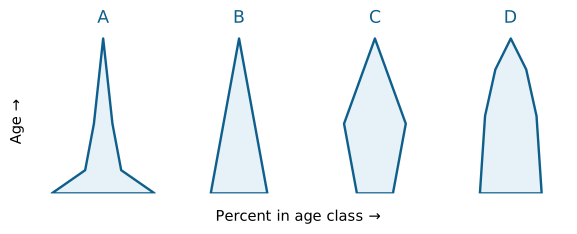
Which one of them indicates the declining population?
The following figure has four curves namely A, B, C and D. Study the figure and answer the item that follows.
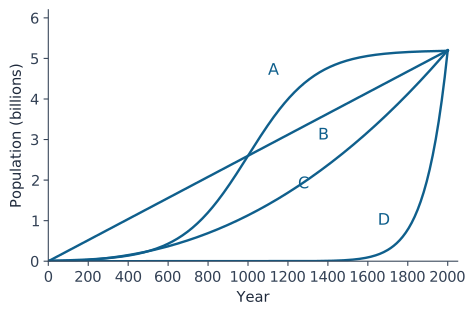
Which curve indicates the exponential growth?
Directions for the following 2 (two) items:
The following pie-charts show the break-up of disease categories recorded in the patients from two towns, Town A and Town B. Pie-charts plot the disease categories as percentage of the total number of patients. Based on these, answer the two items that follow the charts.
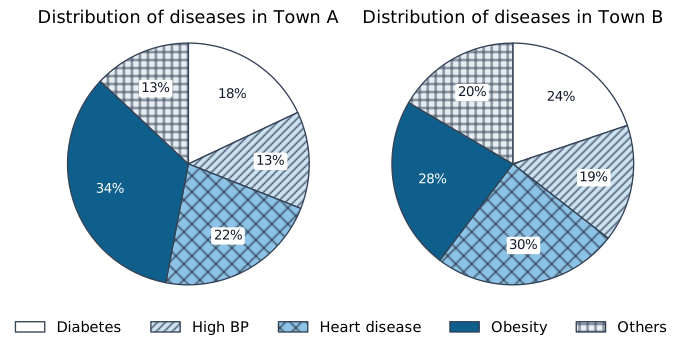
Which of the two towns has a higher number of persons with Diabetes?
Directions for the following 2 (two) items:
The following pie-charts show the break-up of disease categories recorded in the patients from two towns, Town A and Town B. Pie-charts plot the disease categories as percentage of the total number of patients. Based on these, answer the two items that follow the charts.
What can we say about persons with more than one disease from these graphs?
Consider the following Velocity-Time graph. It shows two trains starting simultaneously on parallel tracks.
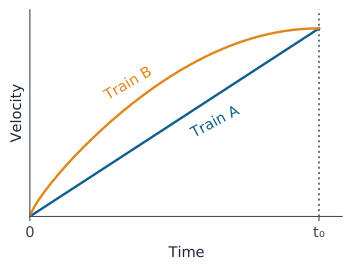
With reference to the above graph, which one of the following statements is not correct?
Consider the following distance-time graph. The graph shows three athletes A, B, and C running side by side for a 30 km race.
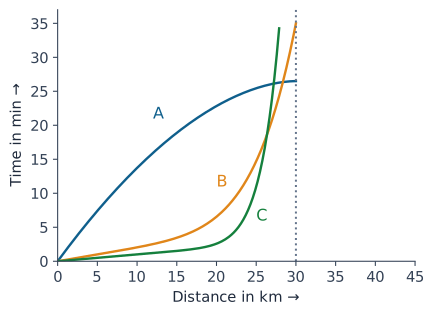
With reference to the above graph, consider the following statements:
1. The race was won by A.
2. B was ahead of A up to 25 km mark.
3. C ran very slowly from the beginning.
Which of the statements given above is/are correct?
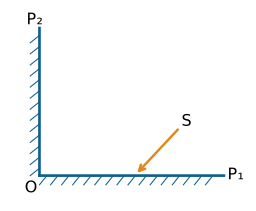
Consider the figure given below and answer the items that follows: In the figure shown above, OP 1 and OP2 are two plane mirrors kept perpendicular to each other. S is the direction of a beam of light falIing on the mirror OP1. The direction of the reflected beam of light from the mirror OP2 will be
Directions for the following 3 (three) items:
Read the passage given below, study the graph that follows and answer the three items given below the figure.
During a party, a person was exposed to contaminated water. A few days later, he developed fever and loose motions. He suffered for some days before going to a doctor for treatment. On starting the treatment, he soon became better and recovered completely a few days later. The following graph shows different phases of the person's disease condition as regions A, B, C, D and E of the curve
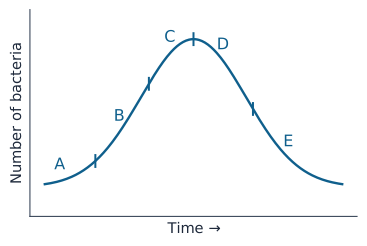
Which region/regions of the curve correspond/corresponds to incubation phase of the infection?
Directions for the following 3 (three) items:
Read the passage given below, study the graph that follows and answer the three items given below the figure.
During a party, a person was exposed to contaminated water. A few days later, he developed fever and loose motions. He suffered for some days before going to a doctor for treatment. On starting the treatment, he soon became better and recovered completely a few days later. The following graph shows different phases of the person's disease condition as regions A, B, C, D and E of the curve
Which region of the curve indicates that the person began showing the symptoms of infection?
Directions for the following 3 (three) items:
Read the passage given below, study the graph that follows and answer the three items given below the figure.
During a party, a person was exposed to contaminated water. A few days later, he developed fever and loose motions. He suffered for some days before going to a doctor for treatment. On starting the treatment, he soon became better and recovered completely a few days later. The following graph shows different phases of the person's disease condition as regions A, B, C, D and E of the curve
Which region of the curve indicates that the treatment yielded effective relief?
You are asked to explain why you did not attend an important official meeting. Your immediate superior had not informed you about the meeting but is now pressuring you not to mention this fact.
What would you do?
A local criminal has illegally occupied your vacant plot. He refuses to vacate it and threatens you with serious consequences unless you sell the property to him cheaply.
What would you do?
You have an important assignment to complete for your headquarters within two days. Suddenly, you meet with an accident and cannot personally complete the work. Your office still expects the assignment to be completed.
What would you do?
You are responsible for providing basic medical facilities to survivors of an earthquake. Despite your best efforts, allegations are made that you have misappropriated relief funds.
What would you do?
You are responsible for urgently hiring boats for flood relief. The lowest quotation from boat owners is approximately three times the government-approved rate.
What would you do?
You are in charge of vaccine distribution in an isolated village affected by an epidemic. Only one vaccine is left. Both the Gram Pradhan and a poor villager require it, and the Gram Pradhan is pressuring you to give it to him.
What would you do?
You have established night shelters for homeless people during winter. Within a week, local residents complain that thefts have increased and demand that the shelters be removed.
What would you do?
As an administrative authority, you are approached by the daughter-in-law of an influential person. She alleges harassment by her in-laws because of insufficient dowry. Her parents are unable to approach you because of social pressure.
What would you do?
The houses of A and B face each other on a road going north-south; A's being on the western side. A comes out of his house, turns left, travels 5 km, turns right, travels 5 km to the front of D's house. B does exactly the same and reaches the front of C's house. In this context, which one of the following statements is correct?
Consider the following figures:
| 2 | 6 |
|---|---|
| 80 | 24 |
| 3 | ? |
|---|---|
| 120 | 36 |
What is the missing number?
In a queue, Mr. X is fourteenth from the front and Mr. Y is seventeenth from the end, while Mr. Z is exactly in between Mr. X and Mr. Y. If Mr. X is ahead of Mr. Y and there are 48 persons in the queue, how many persons are there between Mr. X and Mr. Z?
In a survey regarding a proposed measure to be introduced, 2878 persons took part, of which 1652 were males. 1226 persons voted against the proposal, of which 796 were males. 1425 persons voted for the proposal. 196 females were undecided.
How many females voted for the proposal?
In a survey regarding a proposed measure to be introduced, 2878 persons took part, of which 1652 were males. 1226 persons voted against the proposal, of which 796 were males. 1425 persons voted for the proposal. 196 females were undecided.
How many males were undecided?
In a survey regarding a proposed measure to be introduced, 2878 persons took part, of which 1652 were males. 1226 persons voted against the proposal, of which 796 were males. 1425 persons voted for the proposal. 196 females were undecided.
How many females were not in favour of the proposal?
Statement:
A recent study shows that children below five die in the cities of developing countries mainly from diarrhoea and parasitic intestinal worms.
Courses of Action:
I. Government of developing countries should take adequate measures to improve hygienic conditions in the cities.
II. Children below five years in the developing countries need to be kept under constant medication.
Statement:
There has been a substantial drop in the number of people opting for new telephone connections from a public-sector telephone company in recent months.
Courses of Action:
I. The public-sector telephone company should immediately set up a committee to identify the reasons for the drop.
II. The public-sector telephone company should offer attractive schemes to retain the existing customers and attract new clients.
Statement:
A speeding truck has seriously injured many persons sleeping on the roadside in the early morning.
Courses of Action:
I. The local administration should immediately put a complete ban on people sleeping on the roadsides.
II. The driver of the speeding truck should be nabbed and tried for the crime he committed.
Statement:
The Supreme Court has directed that there is a need to bring in a mechanism in government functions to make them transparent.
Courses of Action:
I. The Government should immediately appoint a task force to work out the modalities.
II. The Government should appeal to the Supreme Court to reconsider its directive.
Directions for the following 2 (two) items:
Each of the following two items consists of four statements. Of these four statements, two cannot both be true, but both can be false. Study the statements carefully and identify the two that satisfy the above condition. Select the correct answer using the codes given below each set of statements:
Examine the following statements:
1. All animals are carnivorous.
2. Some animals are not carnivorous.
3. Animals are not carnivorous.
4. Some animals are carnivorous.
Directions for the following 2 (two) items:
Each of the following two items consists of four statements. Of these four statements, two cannot both be true, but both can be false. Study the statements carefully and identify the two that satisfy the above condition. Select the correct answer using the codes given below each set of statements:
Examine the following statements:
1. All trains are run by diesel engine.
2. Some trains are run by diesel engine.
3. No train is run by diesel engine.
4. Some trains are not run by diesel engine.
Consider the following argument:
"In, order to be a teacher one must graduate from college. All poets are poor. Some Mathematicians are poets. No college graduate is poor."
Which one of the following is not a valid conclusion regarding the above argument?
Consider following three statements:
1. Only students can participate in the race.
2. Some participants in the race are girls.
3. All girl participants in the race are invited for coaching.
Which one of the following conclusions can be drawn from the above statements?
There are 100 students in a particular class. 60% students play cricket, 30% student play football and 10% students play both the games. What is the number of students who play neither cricket nor football?