
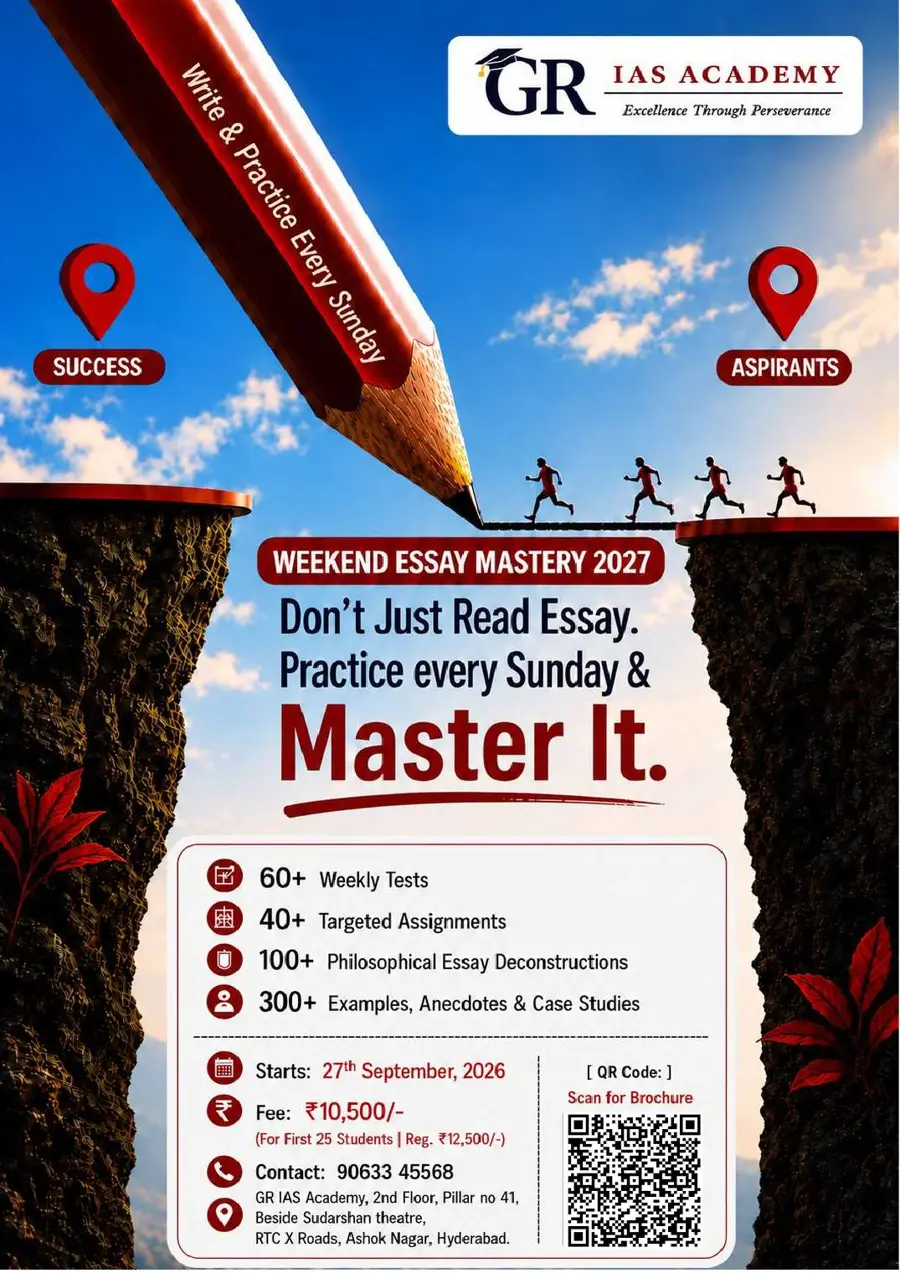
Weekend Essay Mastery 2027
365-Day Transformation Programme · 60+ Tests + 40+ Assignments
Solve the Essay problem before it costs you your rank. Don't just read Essay – practice every Sunday and master it.
✔ Admissions Open | ✔ Only 25 Seats | ✔ Mentor-Guided Evaluation
Essay Is Not Just a Knowledge Test
For many UPSC aspirants, Essay is not a knowledge problem. It is a thinking, structuring and writing problem. Despite strong GS preparation, many lose valuable marks – and sometimes their rank – because they cannot understand the topic, generate dimensions, build arguments and present their thoughts coherently within the time limit.
In GS
The more you read, the more you know.
In Essay
The more you write, the better you score.
Essay paper carries the same marks as any GS paper, yet it does not get the equivalent attention that it deserves from aspirants – first timers and experienced aspirants alike. … Knowledge from GS papers is necessary but not sufficient to score well in the essay paper.
… my essay scores hovered around just 100. Once I realised my failings, I started collecting useful quotes, preparing notes, and even making rough drafts for frequently asked topics in the essay paper. All this effort helped me score 155, much higher than in any GS paper.
One Year. Four Phases. One System.
Transform your essay. Transform your rank.
Foundation Building
Build the foundation of a high-scoring essay
The first three months answer one fundamental question: what exactly does UPSC expect from an essay?
- What exactly is a UPSC Essay?
- How UPSC evaluates an essay
- Understanding the demand of the topic
- Introduction techniques
- Thesis development
- Generating dimensions
- Argument building
- Counterarguments
- 300+ examples and case studies
- Conclusion techniques
- Coherence & logical flow
- Common mistakes that cost marks
Phase 1 Outcome: The student understands how a UPSC essay is constructed – from the first line to the final conclusion.
Thinking Development
From knowing things to thinking in dimensions
A good essay cannot be built by simply dumping knowledge. This phase develops Segmented Multidimensional Thinking – students are trained to systematically generate dimensions from any essay topic.
Example: “The simplest acts of kindness are by far more powerful than a thousand heads bowing in prayer.”
- Break abstract topics into manageable segments
- Identify hidden dimensions
- Connect seemingly unrelated ideas
- Build arguments across dimensions
- Maintain balance and depth
- Avoid repetitive points
- Develop intellectual breadth
Phase 2 Outcome: The student develops the ability to generate multiple, relevant and interconnected dimensions from almost any essay topic.
Writing Mastery
Now we turn thinking into writing
Knowledge and ideas are useful only when they can be converted into a coherent, well-structured essay within a limited time. The intensity of writing increases progressively.
- Think quickly
- Plan efficiently
- Structure arguments
- Maintain coherence
- Write within word and time limits
- Convert knowledge into arguments
- Complete essays without compromising quality
Phase 3 Outcome: Writing stops being an intellectual struggle and starts becoming a trained skill.
Simulators & Ranker Mode
From writing practice to exam performance
No new concepts, no assignments. One essay every alternate day across UPSC PYQs, probable themes, philosophical essays, contemporary issues and full-length simulations.
- Write – one essay every alternate day
- Simulate – 30 exam-oriented tests
- Analyse – mistakes, weak dimensions, gaps in arguments
- Correct – work on individual weaknesses
- Repeat – apply corrections, reduce time
- Perform – a high-scoring essay under pressure
Phase 4 Outcome: From “I can write an essay” to “I can write a high-scoring essay under pressure.”
Programme Details
Frequently Asked Questions
Start Writing Before Essay Starts Costing You Your Rank
Don't wait for the next Mains to discover that Essay is your weak link. Write today. Improve every day. Score in Mains.